
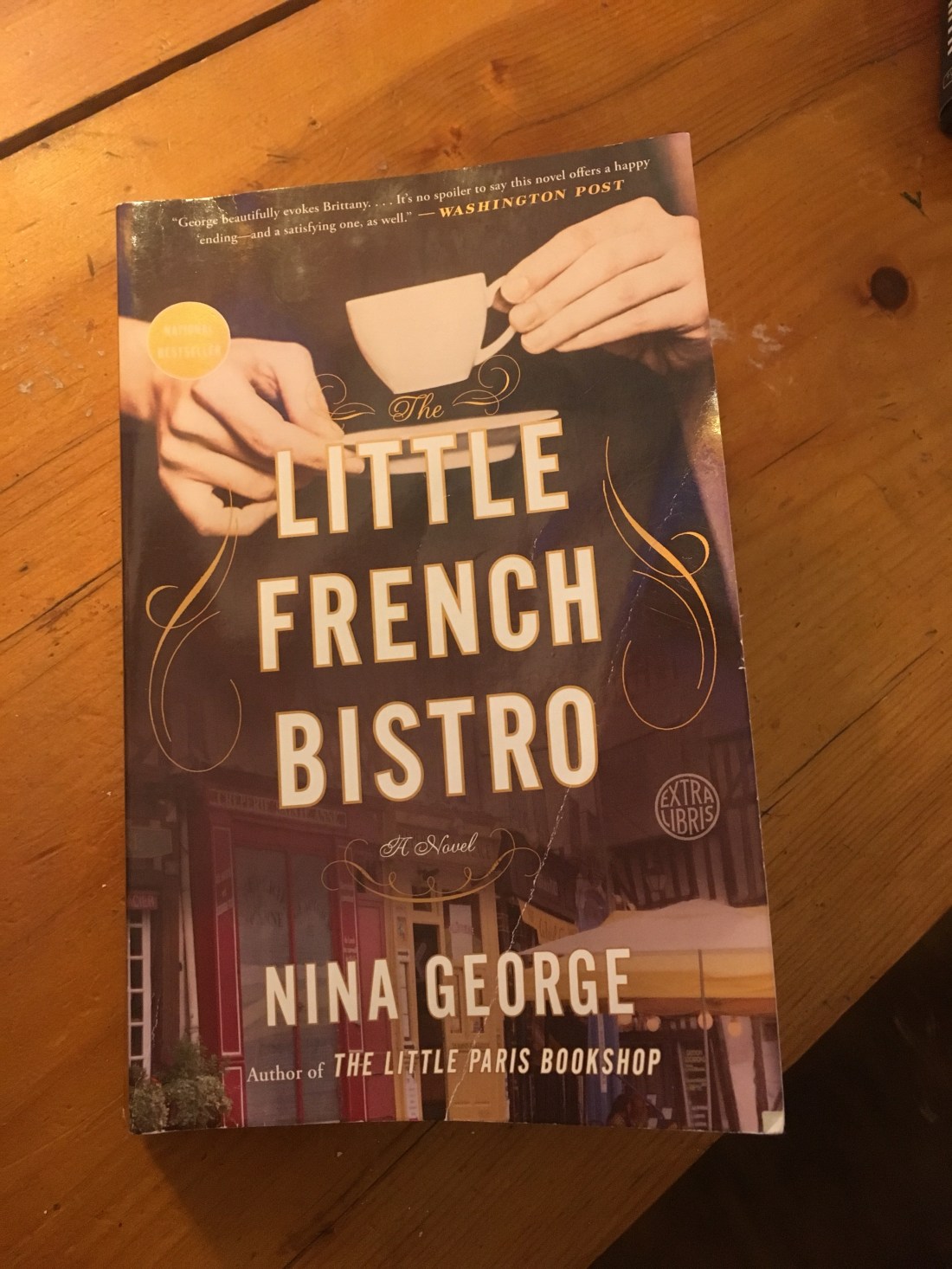
“Emile sat awkwardly beside her on the cold stone floor. He had known Pascale for his whole life. He had seen her in her prime, during her golden age of strength and beauty, and had enjoyed every stage. He knew every woman she’s ever been.” – Nina George, The Little French Bistro
This book has all the charm of a novel set in a small, French village: there is fresh food, fashion, art, a flock of nuns and just about every kind of love imaginable. Broken hearts, unrequited love, one true love, new love, dying love, rekindled love – you name it – The Little French Bistro has it.
The main character, a German woman in her early sixties named Marianne, goes on a bus tour of France with her odious husband, Lothar. When the group is dining at a restaurant in Paris (and Lothar is busy flirting with another woman), Marianne decides she can stand her life no longer and escapes the restaurant to make her way to the Pont Neuf to throw herself off and drown in the Seine. It is the first choice she has made for herself in decades and it exhilirates her to know that she is ending her life on her own terms. Except … she is rescued from the river and rushed to hospital. While confined in the hospital, Marianne finds a little tile with the image of a tiny Breton village, Kerdruc, painted on it and takes it as a sign. She escapes once again, this time to find the village on the west coast of France and drown herself in the sea. When she reaches the village of Kerdruc in Brittany, she finds that day by day her desire to die is replaced by a desire to live. George fills the village with a cast of charming characters who help Marianne to discover who she really is. There were aspects of the novel that reminded me of Joanne Harris’ novel, Chocolat: an outsider coming to town, a handsome young man (but this time he’s more biker than gypsy), a whiff of magic from time to time. But George’s heroine is a little sixty-year-old lady from Germany who arrives with only the clothes on her back and no faith in herself yet eventually she rebuilds her life.
George admits she loves to write about feeling but for me at times, this aspect of the book was overdone. Literally every character – I mean every character – is either in love, falling out of love, wishing for love etc. etc. Because her characters span such a wide range of ages, I think George is trying to show that romantic love is an important part of the human condition throughout our adult lives. Since the love stories are often unconventional, there are times when her characters end up in situations that left me amused or sympathic but I did find it a bit heavy-handed at times.
What I love about this book (See? Love – it’s everywhere) are George’s descriptions of Brittany. I knew nothing about this region of France before reading the book and now it’s on my bucket list. Locals call the region “the end of the world” because it sticks into the Atlantic Ocean. It’s history is old, like giant paleolithic rock structures old (think Stonehenge). The people have their own language – Breton – and can trace their roots to Celts and Druids. In fact, the Bretons consider their history linked with the peoples of Ireland, Scotland and Wales, which makes the connection between Nova Scotia (new Scotland) and Cape Breton (Breton, as in Bretagne, as in Brittany) kind of apt. And Kerdruc is a real village where George happens to live part-time. She describes the region with so much affection for its people and its culture and the land itself that Brittany almost feels like a character in the novel rather that just the setting. She weaves Breton folklore, supersition and language into the book to give the reader a sense of how distinct it is from other regions of France. I admit I was completely charmed by her descriptions.
So if you are in the mood for a love story (or a lot of love stories all at once) or maybe just a quick trip to France without every leaving your living room, you might want to check out The Little French Bistro.
 Little Ms Word Smith