
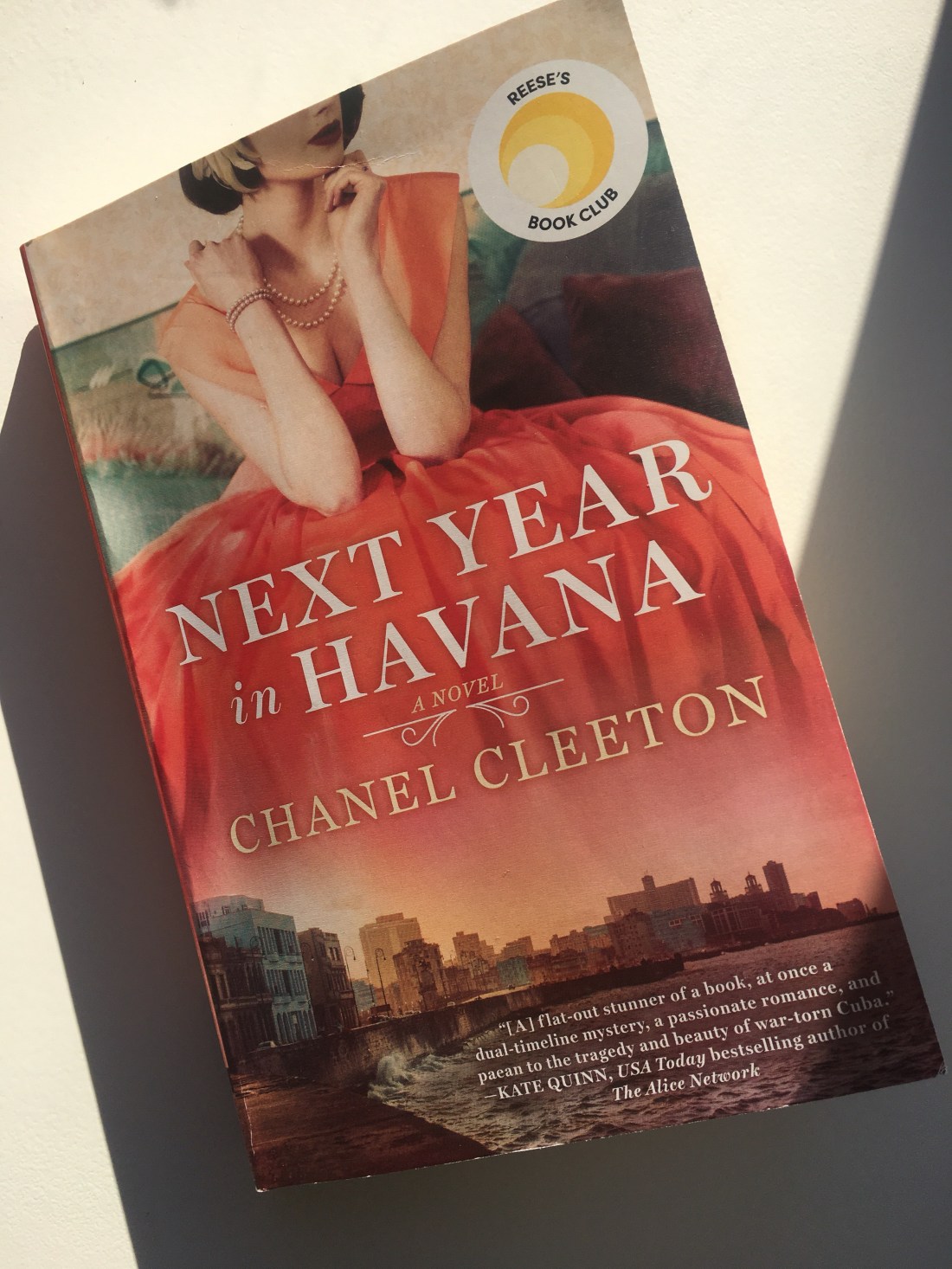
“To be Cuban is to be proud – it is both our greatest gift and our biggest curse. We serve no kinds, bow no heads, bear our troubles on our backs as though they are nothing at all. There is an art to this, you see. An art to appearing as thought everything is effortless, that your world is a gilded one, when the reality is that your knees beneath your silk gown buckle from the weight of it all. We are silk and lace, and beneath them we are steel.” – Chanel Cleeton, Next Year in Havana
The phrase, “next year in Havana” is a toast used within the Cuban exile community in Miami that expresses the now generations-long desire to be able to return to their homeland. The novel is set in two time periods and follows the experiences of two very different women: Elisa, the daughter of a Cuban sugar baron on the eve of the Cuban Revolution, and Marisol, her granddaughter, who grows up in contemporary Miami as a result of Elisa’s family having fled the island years before to avoid reprisals from Fidel Castro’s regime. The novel moves between the two characters’ experiences as Elisa struggles to come to terms with the life she has always known – a world protected by wealth, influence and corruption – crumbles around her, and Marisol’s return to Cuba to spread the ashes of her grandmother on the land she loved. As the story unfolds, a number of family secrets are revealed, including Elisa’s love affair with a Cuban revolutionary that could have torn her family apart.
I really enjoyed this novel. In fact, to get through the 356 pages in a week, I decided I would get up early every day to get some reading in and I found myself looking forward to starting my day with a few chapters with a cup of coffee (let me stress, I am in no way, shape or form a “morning person”). At times, I was frustrated by how oblivious Elisa was to the suffering of the majority of Cuban people while her family lived in a bubble of high society parties, but I also appreciated the ways in which the novel revealed the complexities of being Cuban. Cleeton is the descendant of Cubans who fled after the revolution and Marisol’s character reflects that experience. There are obvious political divides within the novel like those that separate Batista’s supporters from Castro’s but the divides go much deeper. In 1959 when Castro came to power, many wealthy Cubans fled – there is friction to this day between those who left and those who stayed. Many exiles want to see the return of Cuba as it was in their memories, decades ago, and contemporary Cubans living in Cuba are divided between those who support the government and those who seek to overthrow it. As the grandaughter of an exile, Marisol’s understanding of Cuba is shaped by her family’s memories – what they see as ‘preserving’ the Cuba that existed before it was destroyed by the revolution, but this is challenged when she goes to Cuba:
You cannot live in a museum, Marisol. The problem with your ‘preservation’ is that it fails to account for the fact that there is a real Cuba. A living, breathing Cuba. You’re all busy fighting imaginary ghosts in Miami while we’re here, bleeding on the ground, dealing with real problems … You’re still pissed because your grand mansions were taken away and are now occupied by the very men you hate the most. The rest of us are caught in the middle, worrying about how to survive.”
But this is not just a novel that deals with the history or politics of Cuba: it is also a love story. Elisa’s love for Pablo, a revolutionary fighting against everything her family stands for, has the potential to destroy her life; decades later, Marisol goes to Cuba and falls in love with a revolutionary of a sort herself, but Luis is a history professor dedicated to ending the regime of Castro and his followers. Hope and loss are a constant in the novel as each character attempts to define what it means to be Cuban against a shifting and uncertain landscape.
If you are dreaming of an escape to Cuba now that winter really feels like it’s here, then it would be worth picking up Next Year in Havana. The storyline is compelling and emotional and Cleeton’s writing brings to light the beauty of Cuba and its people. If you read this one, drop me a line and let me know what you think. And now off to World War 2 London with Dear Mrs Bird!
 Little Ms Word Smith