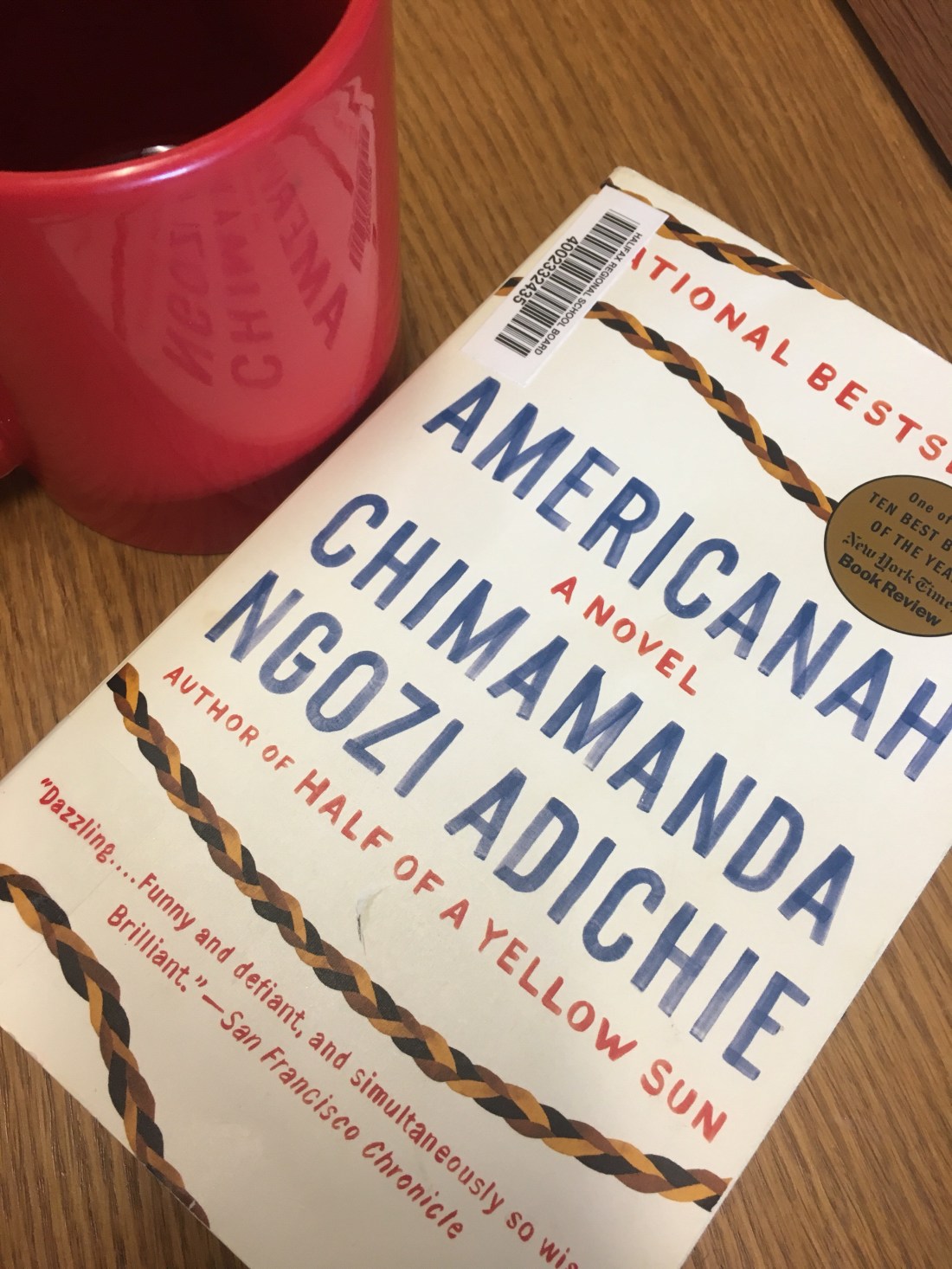
Americanah by Chimamanda Ngozi Adichie: A Review

Hello, hello, hello!

One of the things I have always thought most valuable about books is their ability to put you squarely in someone else’s shoes. As a reader, you have the opportunity to live in many places, in many times and see the world through other people’s eyes. I think readers are naturally curious and books fulfil our desire to know, “what would it be like …?” Reading makes us more empathetic, more aware of the experiences of others whose lives do not mirror our own. And this makes our world bigger and our vision clearer. That is how I felt reading Americanah.

The novel traces the experiences of Ifemelu as she moves from her native Nigeria to the United States and back again. Adichie deals with themes that are ever-present in the modern world: she explores how race, class and beliefs about immigration shape our identities. Adichie is a powerful writer. When I told someone recently that I was reading Americanah, she responded with “whoa, that is a serious book!” It is serious, but not in the sense that the writing is dense or the narrative is overly complex. Ifem’s experiences make the reader reconsider their own cultural contexts. At one point in the novel, when Ifem says she wasn’t black until she came to America, it made me think about how so much of how we see ourselves and how we are understood by others is shaped not only by our character or actions but also how the broader culture perceives people who look like us. In Nigeria, almost everyone is black so it is not race, but more often ethnicity or class that become the dividing lines and Adichie explores these divides throughout the novel.

One of my favourite aspects of Adichie’s writing is her ability to address serious issues like gender inequality, race or class-based prejudices both in Nigeria and the US but still make them feel immediate to the character’s life and therefore to the reader. Ifem blogs about what it is like to be black in America as an outsider to the African-American experience; her choice of hairstyle (whether to relax, cornrow or go natural) becomes a statement of how she sees herself as a black woman; her relationships with boyfriends come to echo her search for the American Dream and then ultimately her return to her roots in Nigeria.

Adichie’s themes are increasingly relevant in the face of the shifting political rhetoric we are witnessing on the world stage lately. Her writing is compelling and Americanah is worth reading because it pushes readers to think and feel beyond their own contexts and to consider the world from another point of view. And maybe as readers we are able to build deeper understanding along the way.
September Line Up

Hello, hello, hello!

First of all, I want to say thank you everyone who took the time to send me encouragement on my first blog post. Putting my little blog into the big wide world is slightly scary so I really appreciated the support and I really hope you will continue to come visit me here so we can talk books.

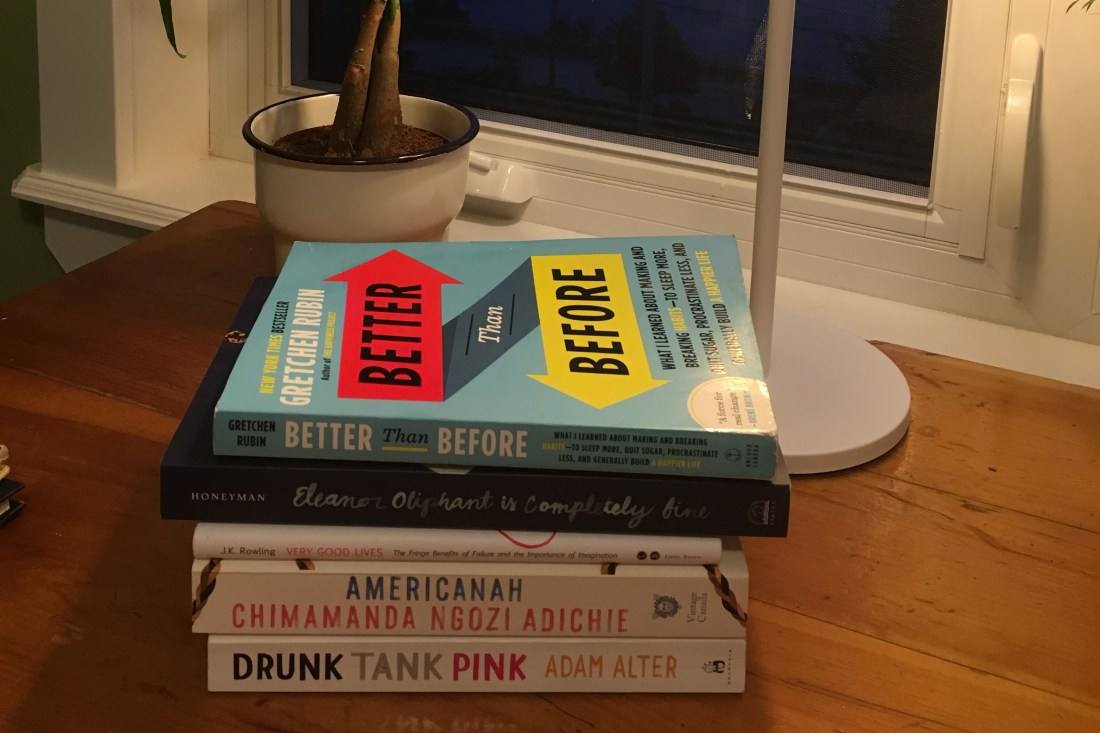
I wanted to give you an idea of the books I’ll be reviewing in September, in case you want to read along – maybe some of them are already lurking in your TRP … time to dust them off! Remember the theme for the month is to try something new or look at something old in a new way so with that in mind, here’s the line up:

September 1: Better than Before  by Gretchen Rubin. As I mentioned in my first post, this is a non-fiction book that focuses on how to make and break habits. Seems like a good place to start at the beginning of a new school year.

September 8: Eleanor Oliphant is Completely Fine by Gail Honeyman. I have to admit, I am a novel snob. They are my first and deepest love so they will pop up regularly on the blog. This novel looks at something old (a love story) in a new way – the protagonist and her love interest are well, weird (the book jacket describes Eleanor as having, “deadpan weirdness and unconscious wit” and her love interest as, “the bumbling and deeply unhygienic IT guy from her office”). So, Romeo and Juliet, they ain’t.

September 15: Very Good Lives: the Fringe Benefits of Failure and the Importance of Imagination by J.K. Rowling. This is actually a published version of a speech Rowling gave at Harvard University. I’m sure you can find it online but I bought the book because, really, she needs the money, poor girl. I’m excited to read it because I think that failure gets a bad rap a lot of the time and as a teacher and a mom, I know that sometimes the most valuable learning experiences we have are from when we fail. Ahem, like when my students or kids fail, we don’t need to get into #momfails here.

September 22: Americanah by Chimamanda Ngozi Adichie. Adichie is a Nigerian-born author and I have read her novel,  Half a Yellow Sun and her short story collection, The Thing Around Your Neck (despite the aforementioned novel snobbery). I really like the way her work examines both Nigerian and Western experiences because it helps you to see things from new perspectives so I am looking forward to reading this one.

September 29: Drunk Tank Pink by Adam Alter. This book looks at how the subconscious shapes our thoughts, feelings and behaviour and besides that awesome title, I decided to add another non-fiction book to this month because my husband read it and talked about it so much that I decided to read it too. It’s also recommended by Malcolm Gladwell in case you don’t want to take my husband’s word for it.

So that’s the line up, folks. There will also be a children’s or YA pick at some point during the month for a Throwback Thursday and I will put out one Bonus Book Blog to try to entice you into reading one of my favourites. Happy reading, everybody!