
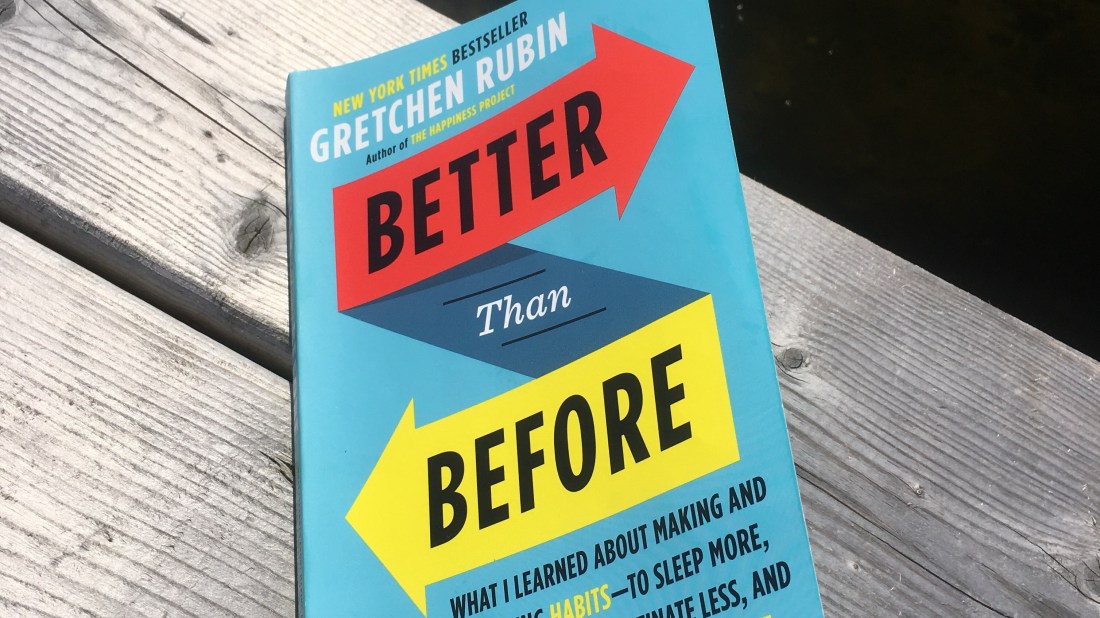
Hello, hello, hello!
“There’s a magic in the beginning of anything. We want to begin right, and a good start feels auspicious.” – Better than Before, Gretchen Rubin
Recently, I became interested in habits. In my personal and professional life, I saw how habits, both good and bad, affect the success, confidence and happiness of those around me. And I am no exception. Like everyone else I know, my life is busy. I struggle to balance parenthood, work and finishing a degree with spending time with family and friends. The secret to maintaining this balance seems to be in cultivating good habits while the ditching bad ones. But after about a year of concerted effort when it comes to habits, I still have questions: why are some good habits easy to form but others always feel like a struggle? I can have the same healthy breakfast every morning without thinking, but I have to make myself get my workout in. Why is it so easy for some people to form certain habits when others find it so hard? A lot of people love to get up early but for me any alarm going off before 7:00 am feels like a punch in the face. The opposite is also true – why do I find it easy to manage the homework in the courses I’m taking when some of my students really struggle to hand work in on time?
Cue Gretchen.
Gretchen Rubin is like that friend who has it all together. Need to know how to carve out some time to yourself in an already hectic schedule? Wondering how to answer that tricky email at work? Trying to help your kids get more organized? Ask Gretchen. To Rubin, one of the keys to increasing happiness is simply habit. Making certain behaviors we value into habits (and avoiding pitfalls) frees us and allows us to use our energy to pursue other things. In this book, she addressed the question: how do we change our habits? And the answer, as in so many things is: it depends.
One of the strongest aspects of Better Than Before is Rubin’s framework for categorizing personalities which she calls the Four Tendencies. She claims that everyone falls into one of four very broad categories: Upholders, Questioners, Obligers and Rebels. These categories relate to how we respond to external and internal expectations. Throughout the book, Rubin uses this framework as a means of exploring why people form habits differently, and explains how understanding your own Tendency is helpful in terms of figuring out how to build or break habits. She uses research and anecdotal evidence from her own life and the lives of her family to support her ideas in ways that makes it easy for readers to relate.
Until reading this book, I didn’t think about most of the things I did on a regular basis (filling the dishwasher before leaving for work, regularly texting friends I don’t get to see very often) as habits. They were just things I did. Re-framing them as habits allows me a different perspective on the things I do and how they reflect (or sometimes fail to reflect) my values. Rubin stresses that to build a happier life, we need to build habits that reflect our values and priorities and in order to do this, we must understand ourselves better. She emphasizes that while we are more alike than we are different, the ways in which people are different are very important (she calls these Distinctions), especially when we’re talking about forming habits. She also introduces her Pillars of Habits: Monitoring, Foundation, Scheduling and Accountability as a means of helping readers establish good habits. She doesn’t shy away from acknowledging that forming habits takes energy and dedication but suggests that the use of her Pillars can help readers be more successful in meeting their habit goals.
So, what are the drawbacks? Remember when I said that Rubin is like that friend with all the answers? For the most part those answers are well thought-out and useful but sometimes she sounds a bit … relentless (which, to her credit, she acknowledges about herself) and that becomes tiresome at times. At one point she talks about going to an acquaintance’s apartment several times to help him clean up his space in order to help him with his writer’s block (she is a strong believer that an uncluttered space leads to mental clarity) and in the end he has to admit to her that the decluttering didn’t help at all. In her estimation, this is an example of how habits work differently for different people but it’s also a bit of a methaphor for the books itself. The central ideas are useful and interesting but in her quest to really get through to readers, the examples tend to get a bit repetative. At times found myself thinking, “Okay, Gretchen, I get it!”
The other thing that surprised me is that she doesn’t really consider emotional factors in the formation and maintenance of habits. This is probably because she is so disciplined herself but I think it’s an important aspect for a lot of people and it is left lacking in this book. She does give a lot of strategies for overcoming potential pitfalls – like abstaining or distracting yourself from temptations – but she doesn’t discuss the emotional connections people often have to their habits.
Overall, I think this is a book worth reading. It makes important points about the way we can connect habits to our own sense of well-being and provides practical tools to help readers work on their own habits.
Curious about which of the Four Tendencies describes you? Take this quiz from Gretchen Rubin’s site. I would love to hear what you find out – post a comment or message me and let me know. Until next week, happy reading!
 Little Ms Word Smith