Drive Your Plow Over the Bones of the Dead by Olga Tokarczuk: A Review

One has to tell people what to think. There’s no alternative. Otherwise someone else will do it.

Olga Tokarczuk

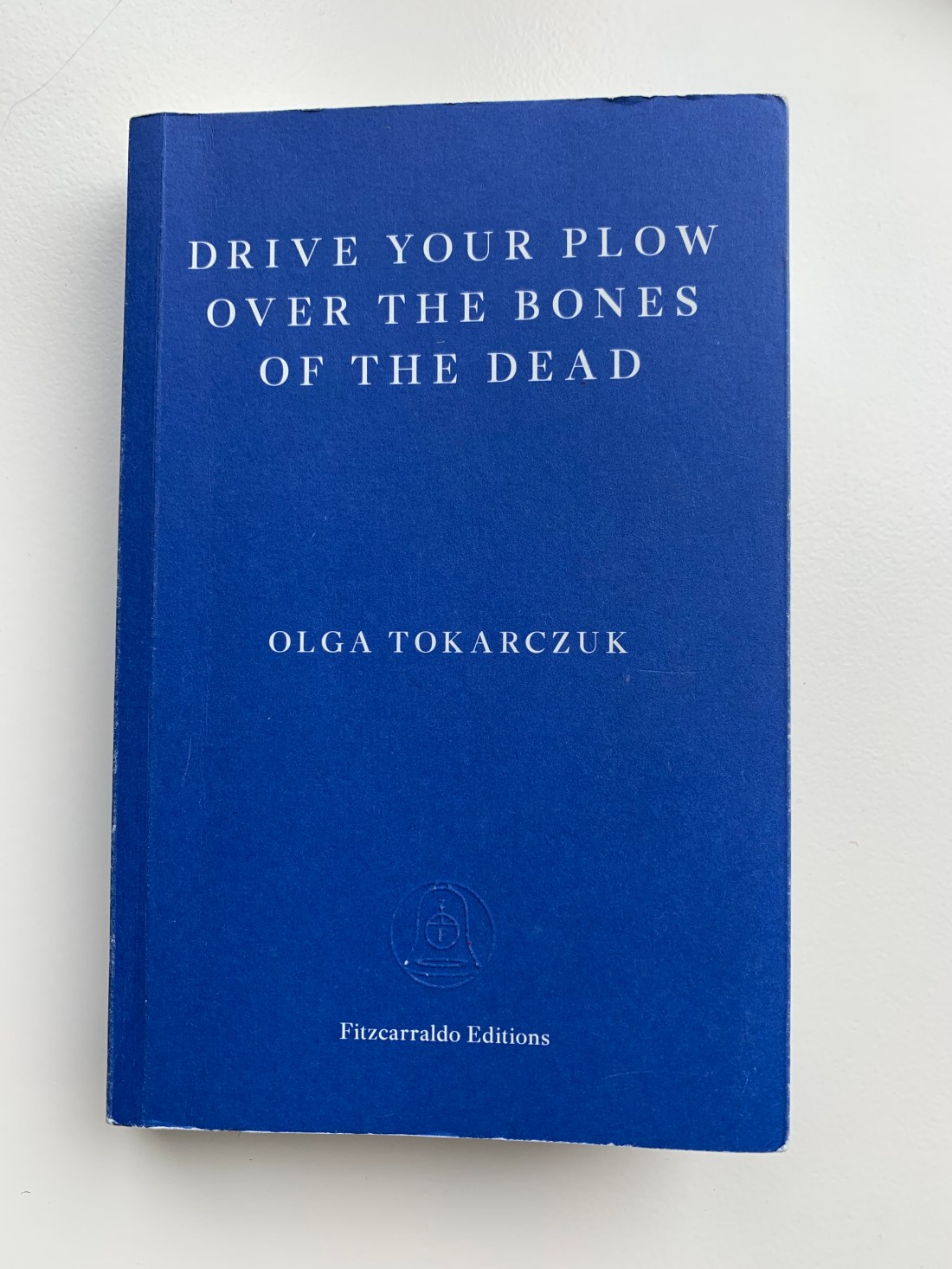
Set in a remote Polish village, Drive Your Plow is a dark comedy wherein the protagonist, Janina Duszejko, an eccentric woman in her sixties, tries to convince her fellow villagers of her Theories. Mrs Duszejko is a firm believer in astrology, the idea that most humans are insufferable and the sanctity of animals. When several men in the village are found dead under suspicious circumstances, Mrs Duszejko believes it is the result of animals taking revenge against humans – particularly hunters – for their cruelty. Some people in the village consider her mad, others see her as an old busybody to be ignored or ridiculed for her beliefs and yet there is a very small group who look past her eccentricities to see her intelligence and keen wit and consider her a friend. This is not a murder mystery in the conventional sense, although solving the murders of the three dead men is central to the plot.

Tokarczuk is a literary superstar in her native Poland. This is the first novel I have read by her. She covers a lot of ground in this book, examining everything from perceptions of madness to animal rights to religious hypocrisy. The story was very original compared to other novels that I have read in that it was part thriller, part dark comedy and part political and social commentary. At times, I found the text to be dense and had to reread passages on more than one occasion. As sometimes is the case with works in translation, I’m not sure if it is how the novel was originally written, or if it is a function of translating Polish into English. Mrs Duszejko and her friend Dizzy deal with this issue themselves to some extent as they struggle to translate the poetry of William Blake (from whose work the book gets its title) from English into Polish. The nuance and challenge of expressing oneself clearly to another is repeatedly examined in the novel.

Despite the somewhat heavy subject matter, the novel is truly funny. Mrs Duszejko refuses to refer to most of the local villagers by their actual names and instead calls them by names she has given them – her neighbours, for example are Oddball and Big Foot. She has a forceful personality and refuses to be put aside by those who would laugh at her or scorn her. It is also in many ways a novel about friendship and holding on to what you value, despite the rules of society. While I did struggle through it at times, I was glad to have read it.

I’ll be putting up posts more frequently this month and next so I am skipping the monthly line-ups and giving myself the freedom to read whatever I feel like next but in case you are missing knowing what is up-coming, I will be posting about The Wonderling, Station Eleven, The Saturday Night Ghost Club, The Care and Feeding of Ravenously Hungry Girls and The Seven Husbands of Evelyn Hugo in the next week or so.

I’d love to hear what is on your summer reading list – let me know what you’ve been reading!

The Almost Sisters by Joshilyn Jackson: A Review

“‘Things feel hard now, but it will pass. Everything passes, and something new comes along to fill the space … You can’t go around holding the worst thing you ever did in your hand, staring at it. You gotta cook supper, put gas in the car. You gotta plant more zinnias'” – Joshilyn Jackson, The Almost Sisters

I have never been to the South (unless you count Florida, and I’m pretty sure Southerners don’t) but I have always loved stories set there. Like in Fried Green Tomatoes at the Whistle Stop Cafe or The Divine Secrets of the Ya-Ya Sisterhood, the South feels more like a character than a setting in Jackson’s novel; it’s hard to imagine the events unfolding as they do anyplace else. The Almost Sisters takes place mainly in the tiny town of Birchville, Alabama – named after the Birch family. The last remaining Birch in Birchville is Leia’s beloved grandmother. When the novel opens, Leia is confronted with several family crises all at once: she finds out she is pregnant and the father is an anonymous Batman she slept with after a drunken encounter at a Comicon, her step-sister Rachel’s marriage has just fallen apart, and then she gets the call to go to Alabama to look after her grandmother, Birchie. Birchie has been hiding her progressing dementia from Leia and it has just outed itself in a very public – and scandalous – way at the local Baptist church’s Summer Fish Fry.

This book is contemporary fiction and I want to say it would make a great summer read, but not in a way that implies it is a marshmallow book by any means. Leia’s return to Birchville unearths family secrets and explores family dynamics in ways that keep the plot moving. It is alternately funny and moving by turns. One of the most poignant moments is when Leia comes face-to-face with the racism that she equates with what she calls ‘the Second South’ – one that white Southerners are aware of, but can never truly experience. Leia’s unborn child is biracial and she has to come to terms with the idea that he could never grow up in Birchville the same way she did as a child because his skin colour would make it impossible.

There are several plot lines that weave together in this novel. Birchie and her best friend Wattie are fighting to maintain their independence, Rachel is trying to pick up the pieces after her husband betrays her and Leia is trying to construct a future for her baby while meeting the deadline for the comic book she has been commissioned to write. Through these women, Jackson is exploring how we create families and how those families shape our own identities, but she does it in a way that is really accessible and keeps you turning the pages. The novel isn’t heavy-handed but Leia is a smart, interesting character and Jackson’s writing keeps the story from becoming sappy or sentimental.

If anyone has read gods in Alabama, another of Jackson’s novels, I would love to hear what you think. And if you are an audio book lover, Jackson is a former actor, and reads her novels herself on audio. I haven’t listened myself but I’ve heard she does a great job.

That wraps it up for this week. Until next time, happy reading!

The Seven Deaths of Evelyn Hardcastle by Stuart Turton: A Review

“How lost do you have to be to let the devil lead you home?”
― Stuart Turton, The Seven Deaths of Evelyn Hardcastle

First of all I have to say, the whole time I was reading The Seven Deaths of Evelyn Hardcastle I was thinking, ‘Stuart Turton is so much smarter than me.’ In this novel, Turton surprised me again and again with the ways he was able to weave a very intricate and intelligent story line into compulsively readable fiction. I love books with interesting narrative structures and I’ve never really read a book like this before. I will try very hard not to reveal anything about the plot that you couldn’t glean from the dust jacket but this book is so page-turning that I just want to shove it into everyone’s hands and say: “read this next!” Turton is able to take genres that feel really familiar and combine them in ways that make his novel fresh and unique. There are big twists in the plot but they never feel gimmicky or unnecessary. There are a lot of lose threads in the story and when they are brought together at the end it just made me sit back and marvel at how Turton was able to do that.

So, no spoilers but how is this for an opening: you suddenly find yourself in the woods with no idea how you got there or who you are. The only thing you think you know for sure is that there are two other people in the forest – a woman named Anna and someone who is trying to kill her. You are terrified and lost. And then the murderer gives you the means to find your way out of the woods and back to the manor house where you are staying. That night, the daughter of the house, Evelyn Hardcastle, will be killed during a lavish party. You have to figure out who her killer is. And you will wake up every day and live the events leading up to Evelyn’s murder over and over until you know who did it.

What made The Seven Deaths of Evelyn Hardcastle so interesting is that Turton moves it beyond a genre-bending murder mystery. As the main character, Aiden, is forced to live the same day again and again, the novel really makes the reader start to question the forces that shape our lives and actions: how much is down to our nature? Can we change or are we following prescribed paths laid out by fate? How far can we trust other people and to what extent should we rely only on ourselves?

I love when a novel can manage to feel suspenseful and smart all at once. Seven Deaths is certainly one I would recommend, especially if like me, you love mysteries and old manor houses and books that take you by surprise. Until next week, happy reading everybody!

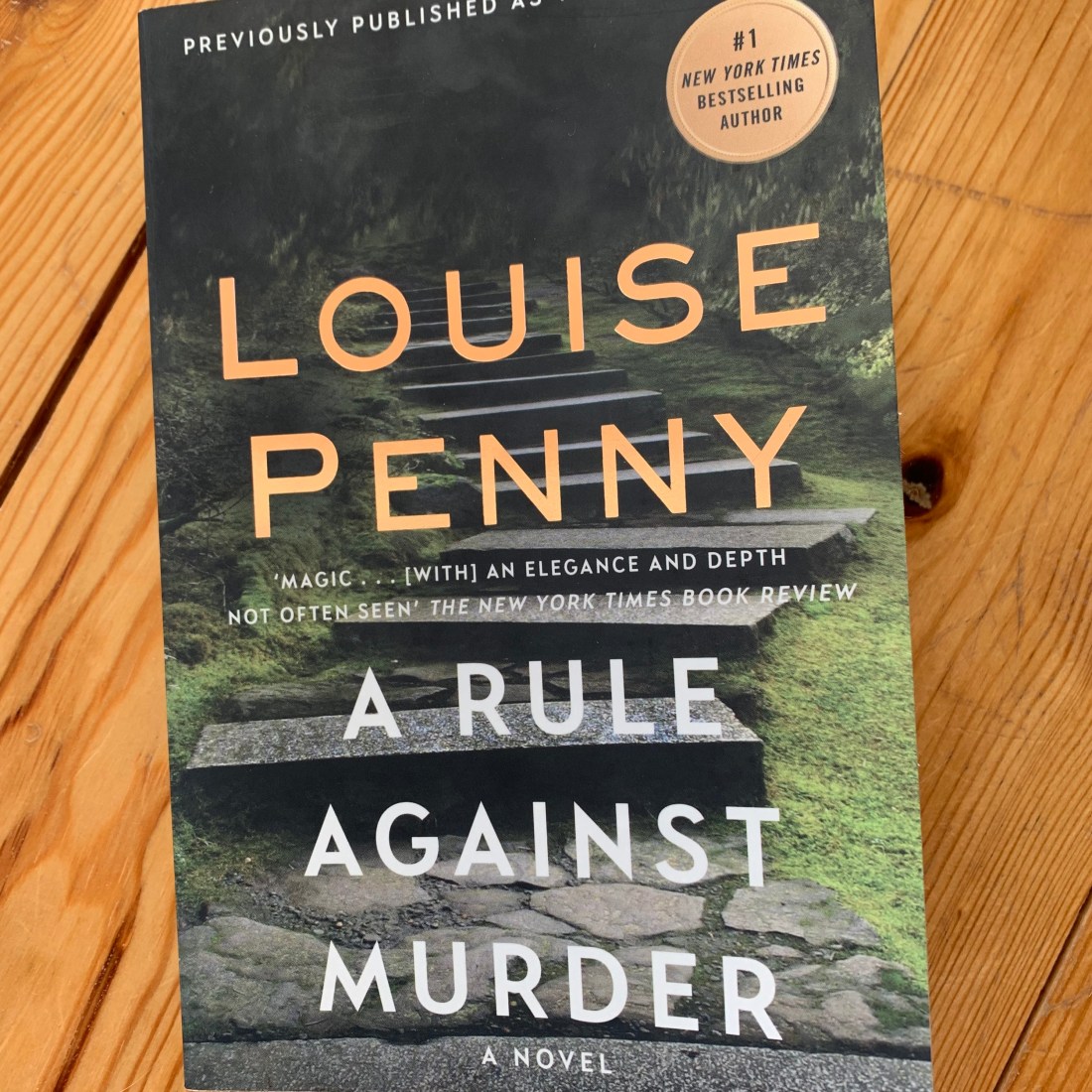
A Rule Against Murder by Louise Penny: A Review

“Not everything needed to be brought into the light, he knew. Not every truth needed to be told. And he knew she was right. He’d seen their faces as she’d fled. She’d said too much. He didn’t understand it, couldn’t see it, but he knew something foul had just come to light, come to life.” – Louise Penny, A Rule Against Murder

When I referred to Penny’s novels as ‘cozy’ mysteries back in the April Line Up post, I didn’t realize that was an actual thing. Cozy mysteries are apparently mystery stories that are not too graphic or too dark, which is an apt description for this series. The main character is Inspector Gamache; head of the homicide team for the Surete du Quebec, Gamache is intelligent and a refined. The novels are set primarily in Quebec, usually alternating between Montreal and the tiny village of Three Pines. While Penny certainly creates intricate plots, her writing does not embrace many tropes of typical mystery series: there are lots of references to art and poetry and music in her books. The female characters are strong and savvy. But what I love most about Penny’s writing is the sense of atmosphere she is able to develop. There is a strong sense of place in her novels and she contextualizes the setting with smatterings of Quebec’s (and Canada’s) culture, history and politics without it overshadowing the story. These are the novels I come back to when I need a break and just want to settle in with characters who feel as familiar as friends.

A Rule Against Murder is set at a remote country manoir where Gamache and his wife are staying. The other guests are members of the Morrow family – wealthy, English and Québécois – all there for a reunion. The Morrows are a family fraught with malice and secrets and when one of them is murdered, it brings to the surface things that have been hidden for years.  The murder and subsequent investigation play out in ways that keep you guessing. One of Penny’s strengths is her ability to create characters that have depth and she uses this depth to add the intrigue in the plot.

I think that her writing really takes off after this book. While this is a good novel, the ones that come later in the series are stronger, in my opinion. I particularly like the later ones set in the village of Three Pines. If you like mysteries and haven’t picked up one of her novels, her fifth, The Brutal Telling might be a good place to start.

If you are reading something you love this spring, drop me a line and let me know. I love hearing other people talk about books they are passionate about. Until next week, happy reading!

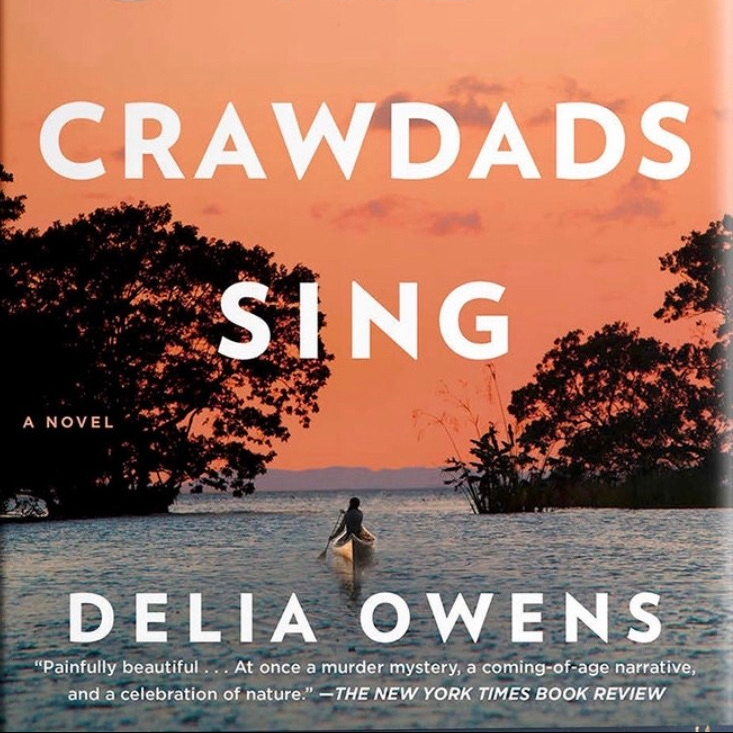
Where the Crawdads Sing by Delia Owens: A Review

“The marsh did not confine them but defined them and, like any sacred ground, kept their secrets deep.” – Delia Owens, Where the Crawdads Sing

Sorry for the stock photo on this post, folks, but I already lent my copy of Where the Crawdads Sing away before I remembered to snap a picture for the blog. I guess it speaks to how good the novel is that I was handing it over to a friend before I even got my review done. The story opens with the discovery of the body of Chase Andrews, a local hero – handsome, star of his football team back in high school, heir to a properous family business – his death becomes the source of speculation and gossip. The circumstances of Chase’s death don’t add up, and quickly the sheriff starts to suspect foul play. The town’s eyes turn to Kya Clark, known by residents as the ‘Marsh Girl’. The narrative moves back and forth between the on-going police investigation into Chase’s death and Kya’s experiences growing up alone in the marsh.

Most of  Where the Crawdads Sing is set in a coastal marsh in North Carolina in the 1960s where Kya makes her home. It is a story of isolation and loss, but also of redemption and hope. As a child, Kya is poor and ends up abandoned by her family. Having lost everyone she loves and terrified of ending up in foster care and taken from her beloved marsh, Kya fends for herself and shies away from the company of others. Living in her family’s shack on the edge of a lagoon, her experiences are largely coloured by loneliness and isolation as she struggles to survive. Her greatest desire is to connect to other people but her unconventional life and the prejudices of the town against the ‘marsh people’ make it seemingly impossible for her to develop relationships. Despite the adversity of her circumstances, in many ways Kya is able to triumph and seems on the verge of finally making a life for herself when Chase’s body was found.

While the framework of the novel seems to be a basic murder mystery in the beginning, this book is so much more. Owens writes poignently about the marsh that sustains Kya over the years and rather than just the setting, the marsh seems to permeate every aspect of the novel. I am not someone normally drawn to nature writing, but Owens’ depictions of the marsh are beautifully handled and evoke a deep sense of place and time. The novel centers around big themes like love, hope and betrayal without becoming sentimental or sacchrine. Owens grounds the reader so well in Kya’s world that you are pulling for her right from the beginning and the novel’s turns mean that the storyline continues to surprise.

I originally bought my copy of Where the Crawdads Sing months ago and then kind of relegated it to my To Read Pile because the blurb made it sound a bit trite. I am so glad that a recommendation encouraged me to bump it up on my reading list because I thouroughly enjoyed it. It’s a really interesting exploration of human nature in all its cruelty and kindness but mostly, I think it’s Owens love letter to the landscape in which the book is set. If you read Where the Crawdads Sing, let me know what you thought. Also, if you, like me, weren’t one hundred percent sure what a crawdad is, they’re crayfish (and they don’t really sing, but they do kind of make a clicking sound). Thanks, Google.


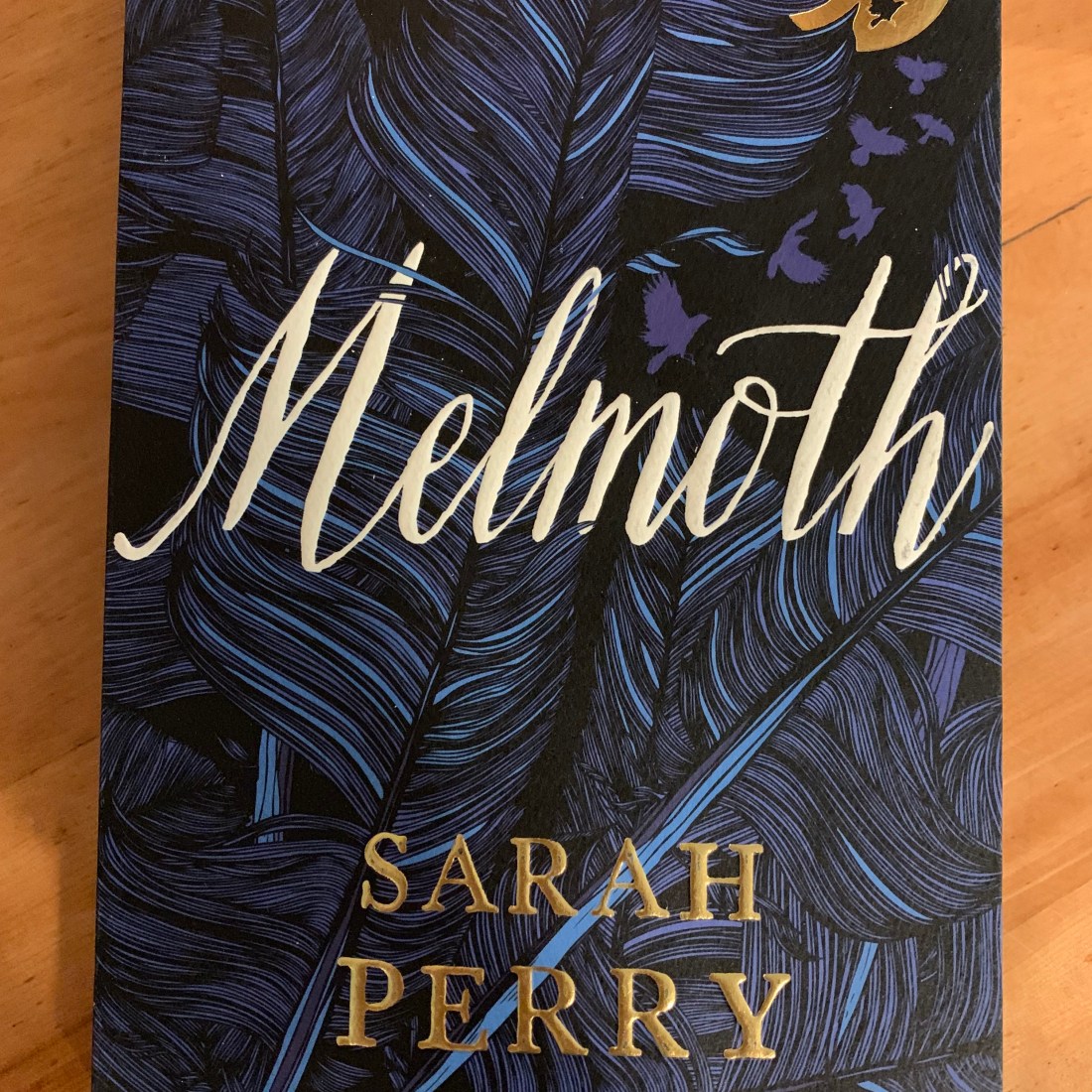
Melmoth by Sarah Perry: A Review

“No librarians yet at their post, the ranks of desks miserably empty, like sockets from which teeth had been pulled.” – Sarah Perry, Melmoth

Well everyone, it finally happened. I wondered when I started this little project when I would start a book I couldn’t finish. This was the one. I was so excited to read Melmoth. The reviews were outstanding and I loved the idea behind the story but readers, I have to be honest, I could not get through this book. I debated making myself finish it since I chose it for the blog, but years ago a wise librarian convinced me that life is too short to make yourself finish reading books you don’t like. So I didn’t. Besides, I decided that explaining why I couldn’t get through it is a review of a sort, so here were go:

Keeping in mind I only made it as far as page 80, I have to say I had a really hard time connecting to this novel. The narrative style is overly wordy in a way that seems like Perry is trying to mimic earlier Gothic writers (think Poe: words, words, words) but to me it felt artificial. The novel is set in modern times so at best it was unnecessary but at worst it felt like Perry was trying too hard to evoke Gothic tropes. The characters were really flat. They seldom express much emotion and when they do, they are kind of awful – one of the characters longs to get away from his wife because she has been paralyzed by a stroke and looking after her depresses him; another rejects other children who try to befriend him because they are nice. I am not kidding. I have read books before where the characters are purposefully unlikable but these ones were also oddly devoid of interesting traits. Even in their pettiness or jealousy or cruelty, they failed to elicit enough of a reaction for me to even care if Melmoth the Witness came and devoured them all in the end (or whatever it is Melmoth does, I guess I’ll never know). I couldn’t like them enough to worry for them or hate them enough to root for their destruction. Characters the reader doesn’t care about is never a good sign.

Before giving up entirely, I went back and read some reviews. I thought there had to be something I was missing. Certainly in the past, I have had to take a couple of running starts at a book before I really got into it and I was hoping the reviews would spur me into action. But as a I scrolled down past all the 5 star reviews that called Perry’s work “sublime” or “masterful”, I found my people. The 1 star reviews that said what I was thinking. The characters in this book are not people I would ever want to sit next to at a dinner party. The writing, while beautiful in places is also really boring at times. And according to the intrepid reviewers who made it all the way to the end, that doesn’t change. There was one common descriptor: depressing.

And with that, suspicions confirmed, I firmly shut the book. There are too many other books I want to read.

Have you ever given up on a book or do you finish whatever you start? I know readers tend to fall into one category or the other so I would love to hear from you. And if you read and loved (or hated) Melmoth, I would be interested to hear that too. Until next time, happy reading!


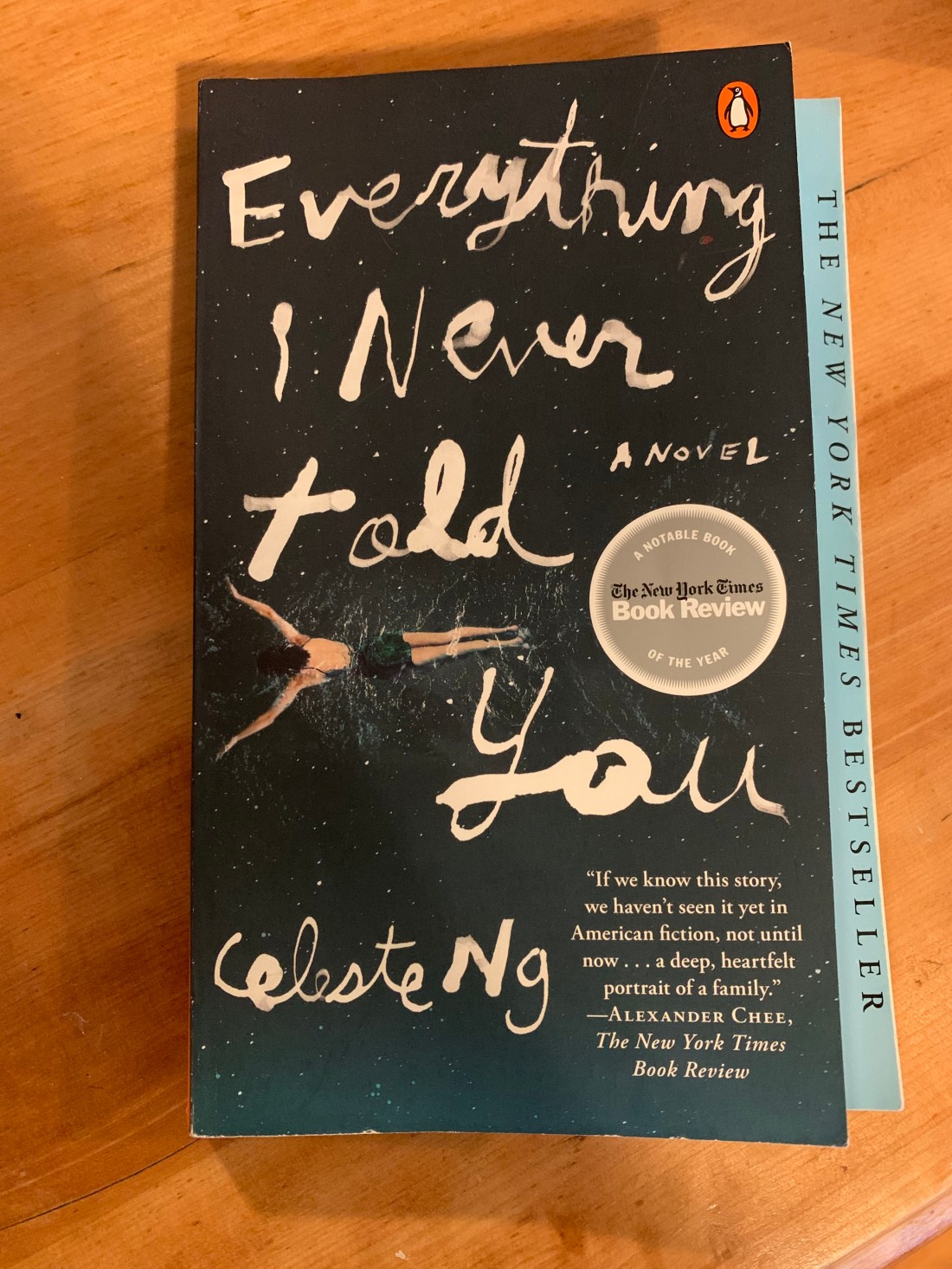
Everything I Never Told You by Celeste Ng: A Review

“Later – and for the rest of his life – James will struggle to piece words to this feeling, and he will never quite manage to say, even to himself, what he really means. At this moment he can think only one thing: how was it possible, he wonders, to have been so wrong.”  – Celeste Ng, Everything I Never Told You

In this novel, Celeste Ng explores what happens to a family when one of the children, Lydia, dies. The circumstances of Lydia’s death are unclear – she left the house in the middle of the night, and later she was found, drowned in the local lake. The family struggles to come to terms with her death – was it murder? An accident? Suicide? And in seeking the answers, they begin to tear apart their bonds as a family. The parents, Marilyn and James Lee, and Lydia’s two remaining siblings, Nath and Hannah, are left protecting their secrets – and each other’s – as they struggle with their grief.

Ng excels at writing work that is both page-turning and deeply sympathetic to her characters. The tension created by Lydia’s death and the resulting reactions of her family developed so much tension that my chest actually felt tight as I read this book. It was only near the end, when Ng reveals the truth about what actually happened to Lydia that I felt like I was able to breathe again. Her writing evokes the vulnerability, loss and pain of her characters so realistically that at times I found it hard to keep reading. Marilyn and James, both thwarted in their own ambitions through circumstance, seek to realize their dreams through their children. The ambitions the Lees have – especially for Nath and Lydia, the two oldest – come from a place of love and the desire to create a better life for them, but result in both children hiding their true selves in an attempt to match themselves to the visions their parents have of them. Only Hannah, the youngest and often ignored child, notices all the small things the others miss: a significant look, a forgotten item, the sound of the front door opening and closing in the middle of the night.

The novel is an exploration of the ways in which families can both save and surrender us. They are the keepers of the deepest secrets, creators of the sharpest cuts. The Lee family clearly loves each other and this makes the story even more painful as the loss of Lydia drives them apart. Ng mingles perception, memory and truth to examine how complicated it is to truly see another, even those we think we know the best.

I have to say between this book and Little Fires Everywhere, any new novels by Celeste Ng will likely go straight to the top of my TRP. Have you read Everything I Never Told You? Drop me a line and let me know what you think. Until next time, happy reading!

January Line Up

Happy 2019 everybody! I hope you rang in the New Year in style. Thank you for all the comments and support in December – I was way behind schedule and you were very patient as I got back on track. It has been incredibly cool to hear all the people who have been reading and sharing the blog and I am really grateful to you for following along with me and sharing the books you are excited about.

I really enjoyed a lot of the books I reviewed last month and I hope my luck holds out for January. The theme for this month is going to be “keeping secrets” for no reason other than that all the books I really want to read next have secrets as a common feature. If you have read any of them, I would love to hear from you!

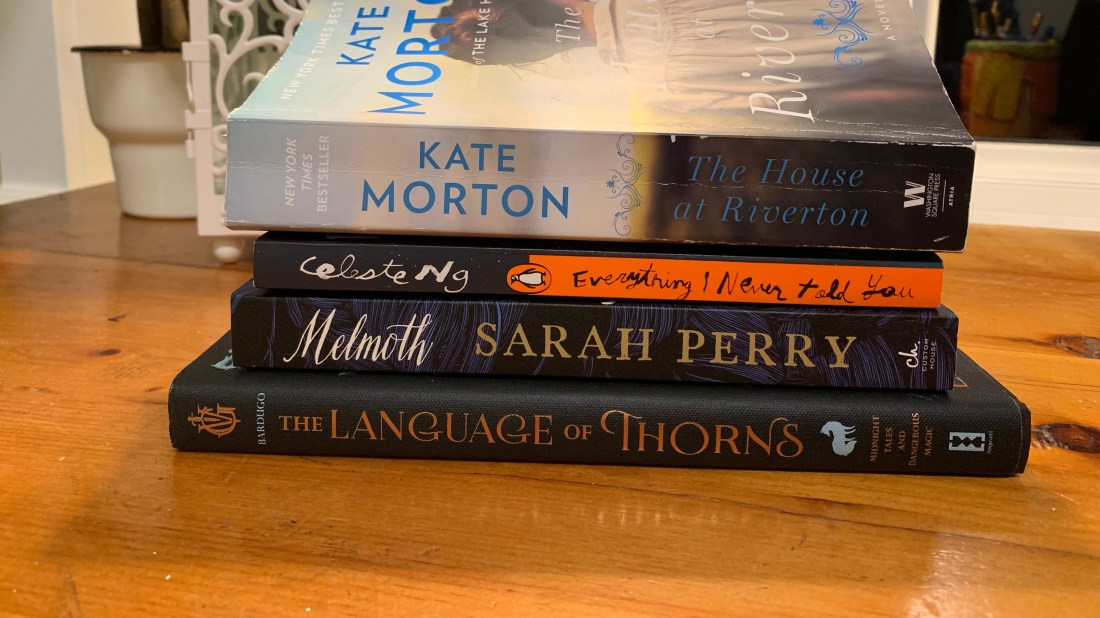
January 5, 2019 – The House at Riverton by Kate Morton

If you are following along at home, you might be thinking, “hey, she was supposed to review that last month.” And you would be right dear reader, but December was a month with 5 Saturdays and the novel is 471 pages long (I already started and it’s really good by the way) and well, I just couldn’t get through it all on time. Luckily, this is my blog and I get to make up the rules as I go along so I am reviewing it as my first book of 2019. (And I will catch up. I promise. Probably not until July though.)

January 12, 2019 – Everything I Never Told You by Celeste Ng

I enjoyed Little Fires Everywhere so much that when I dug Ng’s other novel out of my pile, I couldn’t resist adding it to the January list. The story centers around the death of Lydia, the favorite child of the Lee family. Her death brings secrets to the surface and unravels the bonds that hold the Lees together.

January 19, 2019 – Melmoth by Sarah Perry

This novel is set in Prague but also jumps time and space to 1930s Cairo, the Ottoman Empire during the First World War, Nazi-occupied Czechoslovakia, Manila, central Africa and London. It is modern Gothic (which, if you haven’t noticed yet, I kind of have a weakness for) but seriously – there is a mysterious letter found in a Czech library, a surprise confession, the legend of Melmoth, a dark creature who seeks out the cowardly and complicit across history and a sudden disappearance – how can I resist all that? It seems like a perfect dark story for such a dark month.

January 26 – The Language of Thorns: Midnight Tales and Dangerous Magic by Leigh Bardugo

I am normally not a fan of short stories but I have read Bardugo’s YA fiction and she is a first-rate story teller. Her work infuses elements of fairy tales, folk lore, religion and magic in a world of her own creation. This new book is a collection of modern fairy tales influenced by the stories Bardugo read in her youth. While her subject matter is very different from Ami McKay’s, their writing shares that same quality of stories told by firelight with darkness all around.

I hope there is something here that inspires you to pick up one of these books this month. If you plan on reading any of them along with me, comment and let everything know your thoughts.

Now I have to go – there are still 300 more pages of The House at Riverton to get through before Saturday! Until then, happy reading!


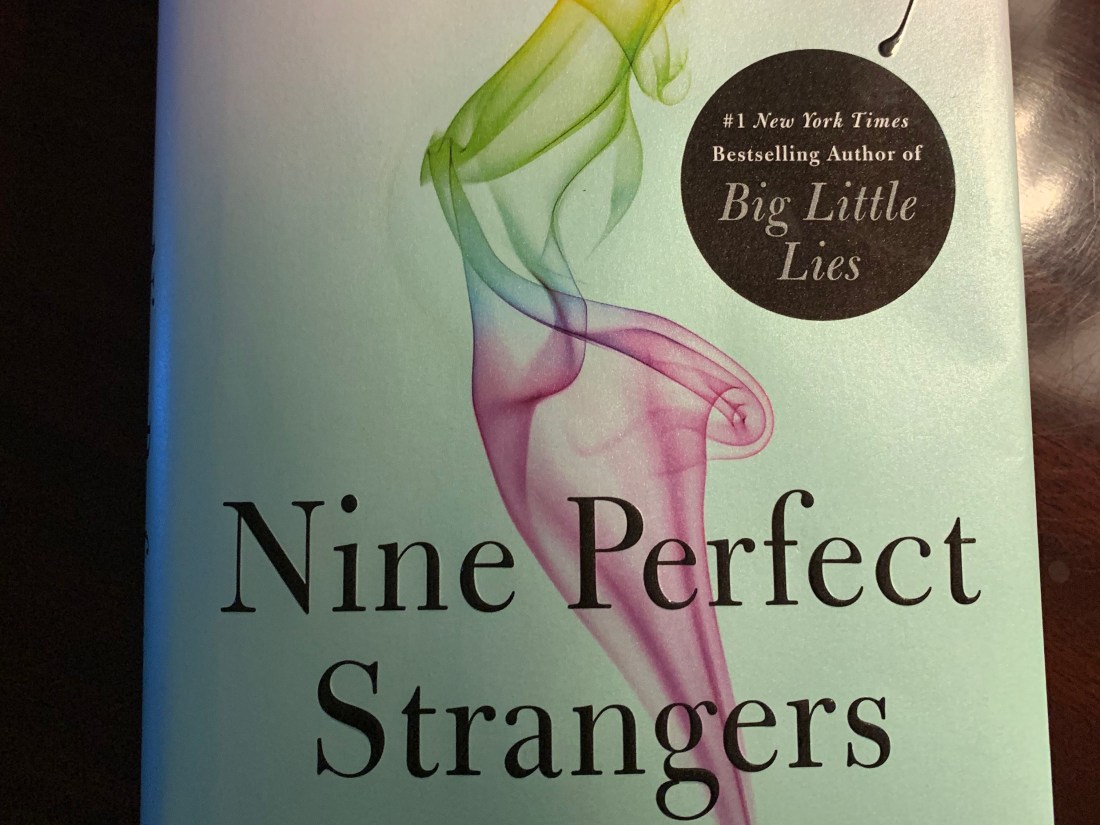
Nine Perfect Strangers by Liane Moriarty: A Review

“I don’t get the obsession with strangers, her first husband, Sol, once said to her, and Frances had struggled to explain that strangers were by definition interesting. It was their strangeness. The not-knowing. Once you knew everything there was to know about someone, you were generally ready to divorce them.” – Liane Moriarty, Nine Perfect Strangers

Nine strangers. Ten days at a remote health resort. All of them are looking to transform their lives at the hands of Masha, the resort’s owner who promises to help them achieve their potential. Each guest arrives with their own hopes and goals, but within days, they are questioning the wisdom of having given themselves over to Masha and her unorthodox “treatments” in their desire to change their lives.

This novel follows the style of Moriarty’s other books. There is a sharp sense of wit as Moriarty takes tongue-in-cheek aim at health resorts, romance novels and our desire for “happily every after” endings but beneath the surface runs a dark undercurrent of obsession, loss and madness. I always enjoy the way that Moriarty is able to take everyday characters – in this case, a novelist, a lawyer, or a teacher – and put them in circumstances that are exceptional to create tension and suspense. Her books are fun, scary and clever.

Nine Perfect Strangers is not my favorite of Moriarty’s novels (although I know some people who think it’s her best so far). I liked the characters and I’m not going to spoil any surprises but I will say that there is a point in the novel for me where the plot came very close to jumping the shark. Regardless, this book was a page-turner and all of the characters do leave Tranquillum House transformed, just not in the ways they expected. The novel is about change – what drives us to change and what holds us back. Moriarty examines how much of life is what happens to us, and how much is shaped by how we handle those events.  But don’t expect this novel to leave you with positive affirmations or new yoga poses … the changes the characters experience come through adversity, not meditation or spa massages.

If you are looking for a novel that is pure entertainment, then this would be a good choice. Until next time, happy reading!

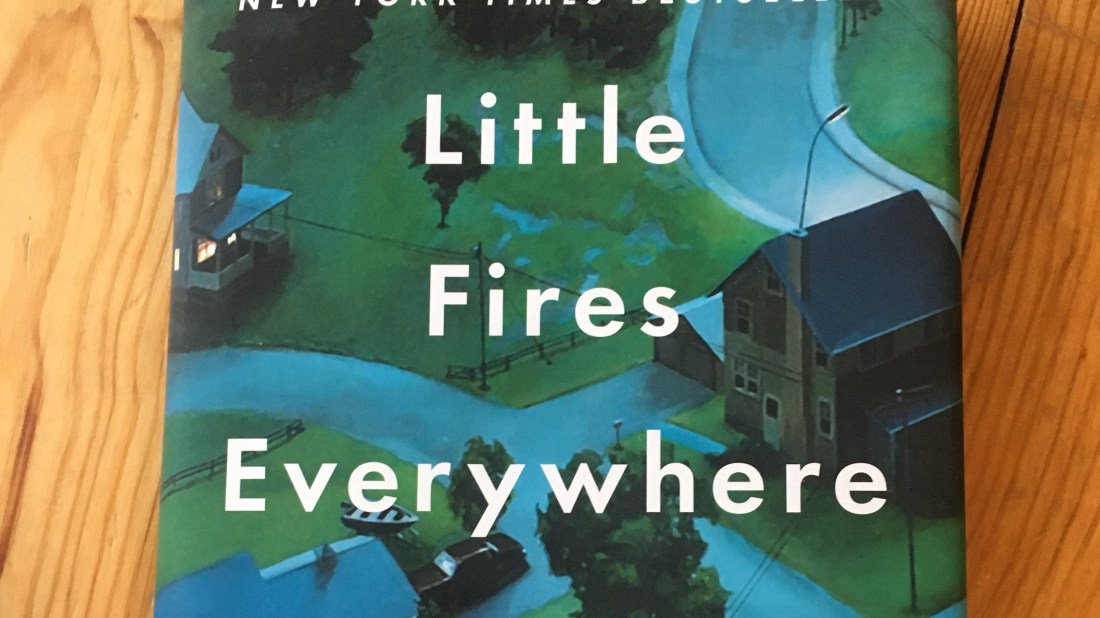
Little Fires Everywhere by Celeste Ng: A Review

“One had followed the rules, and one had not. But the problem with rules… was that they implied a right way and a wrong way to do things. When, in fact, most of the time they were simply ways, none of them quite wrong or quite right, and nothing to tell you for sure what side of the line you stood on.” – Celeste Ng, Little Fires Everywhere

I really, really liked this book. Set in the community of Shaker Heights, Little Fires Everywhere follows the story of two families: the Richardsons – a wealthy family with four teenaged children and their tenant, Mia Warren and her daughter, Pearl. Shaker Heights is a planned community where everything from the layout of the streets to the colours of the houses is carefully designed. The families of Shaker are rich, their children go on to prestigious universities, they give to the right charities, they help those in need. They follow the rules. They do what is right. Nobody embodies Shaker more than Elena Richardson, who was raised in the community and returned there to raise her own family. When Mia moves to Shaker, Elena sees the artist and her shy daughter as an opportunity to help someone deserving. Very quickly the two families become entwined via the children; Pearl becomes a fixture in the Richardson home while Izzy, Elena’s challenging youngest child, comes to idolize Mia. When a white couple in Shaker attempts to adopt a Chinese-American baby who was abandoned by her mother, a custody battle ensues that divides the community, and puts Elena and Mia on opposite sides.

One of the things I most enjoyed about this book was how unexpected so much of it was.  As the novel progresses, secrets are revealed that threaten to pull both families apart. The narrative moves between Elena, Mia and each of the five children. Ng’s writing is like a slow burn. I found myself drawn in almost without noticing, and then I couldn’t stop reading. Ng reveals the complexities of family, especially the relationships between mothers and their children. She also examines what it means to follow the rules, and what it means to break them. Both Elena and Mia are strong characters with faith that their actions are the right ones and this sets them on a path that will eventually result in heartbreak for both of them. I think the reason the novel works so well is because Ng is careful not to create heroes or villains. Each character’s choices and feeling are understandable given their circumstances and this makes the events that unfold – some of them shocking – feel inevitable. Ng’s writing creates an immersive world in the suburbs of Cleveland that feels both familiar and alien as she pushes the readers’ boundaries about who is right and who is wrong in the conflicts she creates.

If you are looking for a book to read in the new year, you should pick up Little Fires Everywhere. I would really love to hear what you think about it and if you loved it as much as I did! Until next time, happy reading!