
Hello, hello, hello!
“Had I really succeeded at anything else, I might never have found the determination to succeed in the one arena where I believed I truly belonged.” – Very Good Lives, J.K. Rowling
As a high school teacher, I have sat through a lot of graduation ceremonies. A lot. Graduations, like any ceremony, tend to follow fairly prescribed routines and it is really only when someone gets up to speak – a valedictorian, a visiting dignitary – that there is a chance to make a unique mark among all the pomp and circumstance. So maybe it was as a result of having sat through all these occasions that I was interested reading what J.K. Rowling had to say when she was asked to deliver the commencement address at Harvard University.
Rowling’s rags-to-riches story is well known, so when I saw her two themes were the benefits of failure and the importance of imagination, I thought she would be speaking about her experiences writing Harry Potter and the Philosopher’s Stone as an impoverished single mom.
I’ll admit I was being a bit cheeky in the September Line Up about my decision to purchase this book (which can effectively be read in less than twenty minutes) but in truth, proceeds from the purchase of the book go to Lumos, a charity founded by Rowling to help disadvantaged children and to provide financial aid for students attending university. The speech is complimented by simple but appealing graphics and I couldn’t help but think as I read it about what a beautiful gift it would make, maybe for someone starting a new chapter of his or her own life (please, no more Oh, The Places You’ll Go!) or someone who might need to see a failure as a chance to start fresh, or imagination as a means of changing the world around them.
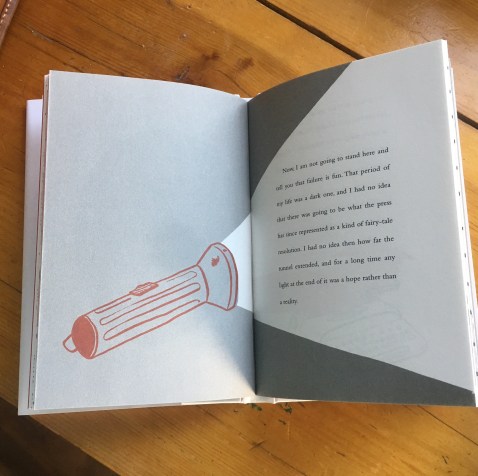
Rowling’s discussion of failure does not include how many publishers turned down her manuscript before she finally landed a book deal; instead, she focuses on the failures in her own life as being opportunities. After all, once you hit rock bottom (and Rowling’s experiences included a failed marriage, trying to raise her child on her own and having no money to speak of) there is nowhere to go but up. She does not romanticize the difficult parts of her life and she reminds readers that while the media likes to portray her life as having a fairy-tale ending, there was no way she could have known at the time that there was any light at the end of the tunnel. Instead she focuses on the benefits of failure: when you have tried and failed again and again, failure helps you to see yourself and what you value more clearly. As she herself states, if she had not failed as so many other things, she may never have found the courage to do what she really wanted to – write.
Her discussion of imagination is interesting too in that it is tied to her real-life experiences. As a young woman, Rowling worked in the UK for Amnesty International. Her experiences there both exposed her to the horrors people around the world were facing (many such people went through her office on a regular basis) and to the incredible kindness and reliance people can embody despite living through trauma. Rowling argues that it is through imagination that we can put ourselves into another person’s shoes and that once done, it is impossible to be blind and deaf to the suffering of others. Imagination is not just for the conjuring of fictional worlds but also allows us to move beyond our own life experiences to connect with the experiences those outside our reach. She also underscores that when we live a life of privilege – as many in her Harvard audience that day did – it is even more important to use imagination as a tool for empathy because otherwise privilege can act to insulate one from others’ realities. In Rowling’s mind, imagination is the tool that spurs us to act, to help, and to better understand.
I’m not going to say that this should be on the top of your to read pile, but I do think the speech reveals some important insights about the roles of failure and imagination and opportunities to consider them in new ways.
 Little Ms Word Smith